
Disillusionomics
When the System Stops Working—and Why Bitcoin Changes the Equation

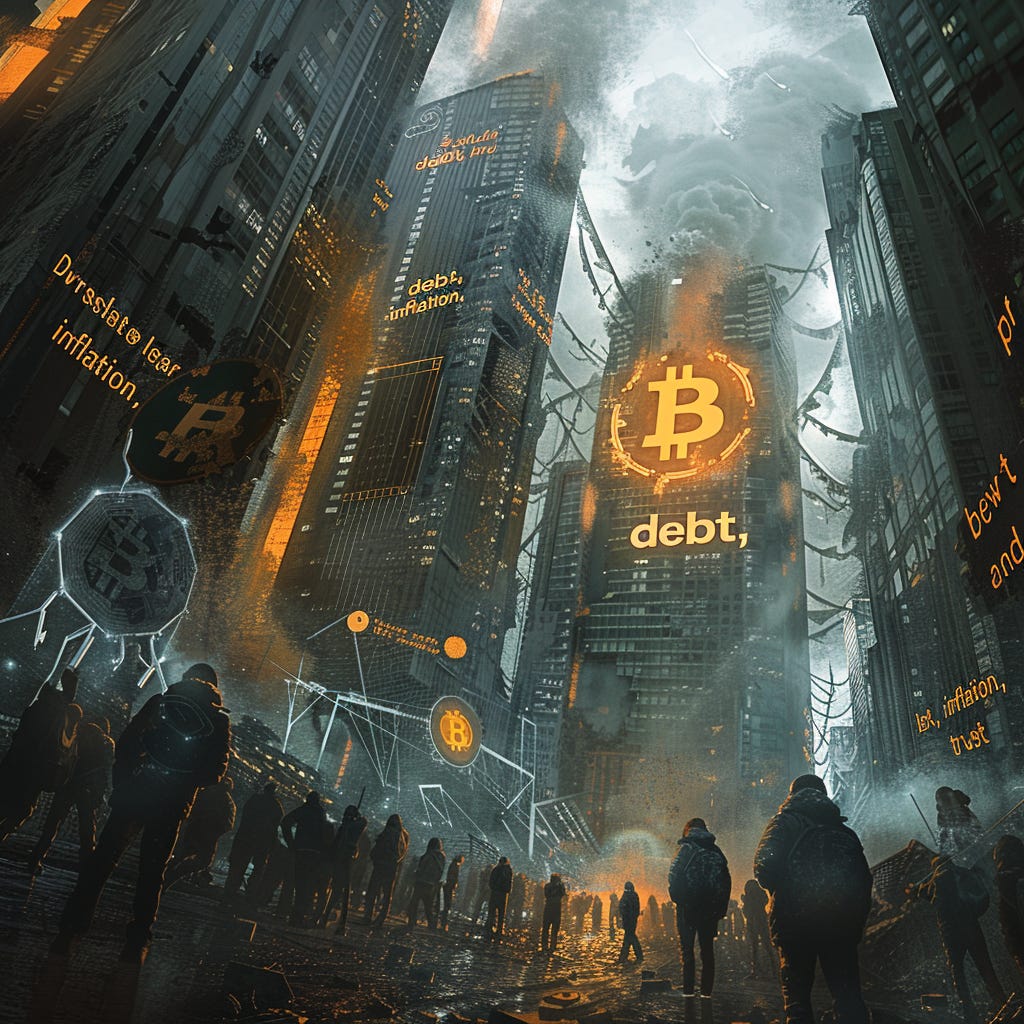
There’s a quiet shift happening.
You can feel it in conversations, in headlines, in the tone people use when they talk about money, careers, and the future. It’s not panic. It’s not even outrage.
It’s something more subtle—and more powerful.
It’s disillusionment.
Welcome to what I call Disillusionomics: the study of what happens when people stop believing the economic system works for them.
The Promise
For decades, the formula was simple:
Work hard.
Save diligently.
Invest wisely.
Trust the system.
Do those things, and over time, your purchasing power would grow. Your life would improve. Your children would be better off than you.
This wasn’t just an idea—it was a social contract.
The Reality
For a growing number of people, that contract feels broken.
Wages have not kept pace with the cost of living
Housing has become unaffordable in many cities
Healthcare and education costs continue to rise
Saving in cash guarantees a slow erosion of value
Meanwhile, asset prices—stocks, real estate, collectibles—have surged.
If you owned assets early, you benefited.
If you didn’t, the ladder moved higher.
This divergence didn’t happen by accident.
The Mechanism
To understand disillusionment, you have to understand the system itself.
Modern economies are built on fiat money—currency that can be created at will by central authorities. When crises hit, the response is almost always the same:
More liquidity.
Lower interest rates.
Expanded balance sheets.
This was on full display during the 2008 Financial Crisis and again in the years that followed.
The intention was stabilization.
The result was distortion.
New money doesn’t enter the system evenly. It flows first into financial assets—stocks, bonds, real estate—pushing their prices higher. Those closest to the source benefit most.
Over time, this creates a widening gap between:
Asset owners
Wage earners
And that gap is where disillusionment grows.
The Psychological Shift
Disillusionomics isn’t just about economics—it’s about expectations.
People can tolerate hardship.
What they struggle with is unfairness.
When the rules feel consistent, people play the game.
When the rules feel rigged, they start looking for an exit.
You see it everywhere:
Declining trust in institutions
Rising political polarization
Increased interest in alternative systems
A growing sense that the old playbook no longer works
This is not a fringe phenomenon. It’s becoming mainstream.
The Search for an Exit
When belief in the system erodes, people don’t just complain—they adapt.
Some take on more risk.
Some disengage entirely.
Some turn to parallel systems.
And increasingly, some discover Bitcoin.
Bitcoin as a Response to Disillusionment
Bitcoin isn’t just a technology. It’s an answer to a question many people didn’t know how to ask:
What if the problem isn’t you—but the money itself?
Bitcoin flips the script in several important ways:
1. Fixed Supply
There will only ever be 21 million Bitcoin.
No central authority can dilute it.
No policy decision can change it.
This directly counters the quiet erosion of purchasing power that defines fiat systems.
2. Equal Access
Bitcoin doesn’t care who you are.
There are no gatekeepers.
No privileged access.
No insider advantage.
The rules are the same for everyone.
3. Self-Custody
With Bitcoin, you can hold your own wealth.
No bank required.
No counterparty risk.
No permission needed.
In a world of declining trust, this matters.
4. Transparency
The system is open and verifiable.
Anyone can audit the supply.
Anyone can run a node.
Anyone can verify their own transactions.
Contrast that with opaque financial systems where trust is required but rarely earned.
A New Framework
Disillusionomics doesn’t mean the world is ending.
It means people are waking up.
They’re questioning assumptions.
They’re reevaluating strategies.
They’re looking for systems that align with reality—not promises.
Bitcoin is one of those systems.
Not because it’s perfect.
But because it’s different in the ways that matter.
The Turning Point
Every system runs on belief.
For decades, people believed:
Their money would hold value
Their efforts would be rewarded
The system was fundamentally fair
Today, that belief is fading.
And as it fades, something new is emerging.
A parallel system.
A new standard.
A different way to store the value of your time and energy.
Final Thought
Disillusionment is often seen as negative.
But it can also be the beginning of clarity.
When illusions fall away, you’re left with a simple question:
What actually works?
More and more people are arriving at the same answer.
Not through ideology.
Not through speculation.
But through experience.
And that answer is Bitcoin.
Bitcoin Fortress — Building one block at a time.
Not financial or legal advice, for entertainment only, do your own homework. I hope you find this post useful as you chart your personal financial course and Build a Bitcoin Fortress in 2026.
Thanks for following my work. Always remember: freedom, health and positivity!
Please also check out my Bitcoin Fortress Podcast on all your favorite streaming platforms. I do a weekly Top Bitcoin News update every week on Sunday, focused on current items of interest to the Bitcoin community. Please check it out if you haven’t already. Also now on Fountain, where you can earn Bitcoin just for listening to your favorite podcasts.
Also, check out my books:
Follow me on Nostr:
npub122fpu8lwu2eu2zfmrymcfed9tfgeray5quj78jm6zavj78phnqdsu3v4h5
If you’re looking for more great Bitcoin signal, check out friend of the show Pleb Underground here.