
Bitcoin vs Currency Debasement
How Money Loses Value Over Time

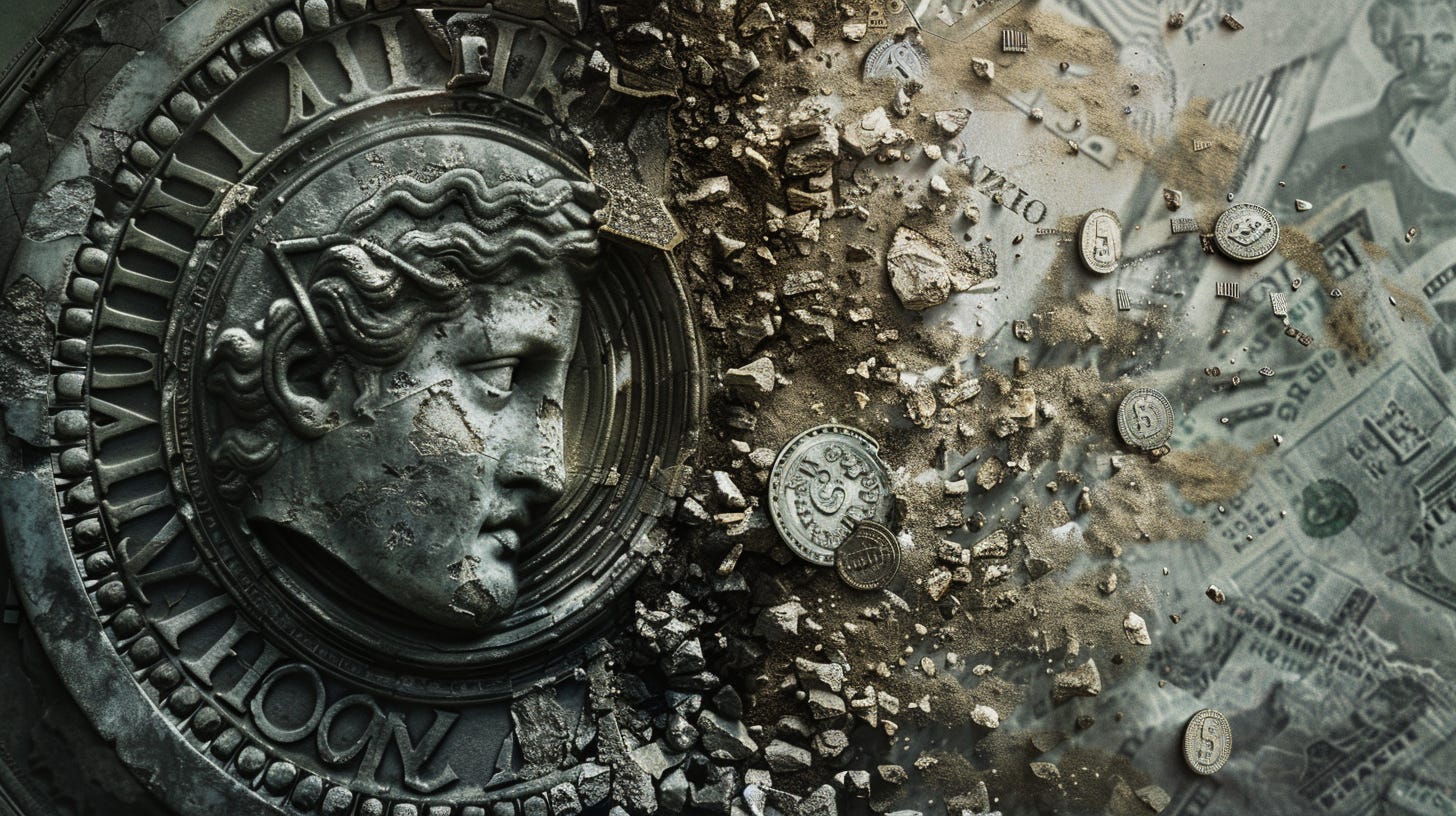
A dollar today still says “one dollar.”
The number printed on the note has not changed.
The digital balance in a bank account still appears stable.
A hundred dollars still looks like a hundred dollars.
And yet, what that money can buy changes constantly.
This is one of the defining features of modern money:
Its face value remains fixed.
Its purchasing power does not.
That distinction matters.
Historically, debasement was often visible. Coins were clipped. Precious metal content was reduced. The currency itself changed physically.
Today, the process is more abstract.
The unit remains the same.
Its value erodes over time.
That is modern debasement.
When Money Kept Its Name but Lost Its Substance
Currency debasement is not a new phenomenon.
Long before central banks, fiat currencies, or digital money, states faced a familiar problem: obligations exceeded available resources.
Wars had to be financed.
Bureaucracies had to be maintained.
Public promises had to be honored.
Raising taxes directly was politically painful. Borrowing had limits. Default carried risk.
So rulers often turned to the money itself.
In the Roman Empire, one of the clearest examples was the denarius, a silver coin that served as a core unit of account for centuries. Over time, emperors reduced the silver content of the coin while keeping its face value intact.
The coin retained its name.
It lost its substance.
This allowed the state to stretch its resources further in nominal terms. More coins could be minted from the same amount of precious metal. The fiscal pressure was relieved temporarily.
But the economic consequences followed.
As the underlying substance of the currency weakened, trust in the money declined. Prices adjusted. Purchasing power deteriorated. The coin still circulated. It simply carried less value than before.
The mechanism was visible.
The incentive was timeless.
The Modern Version of the Same Process
Today, governments do not reduce the silver content of coins to manage fiscal strain.
Modern currencies are not primarily backed by precious metal. They are managed through central banking systems, sovereign debt markets, and policy institutions.
But the underlying incentive remains remarkably similar.
When states face large obligations, the easiest adjustment is often not explicit taxation, severe austerity, or outright default.
It is debasement.
Only now, debasement occurs differently.
Fiat currencies are not clipped.
They are diluted.
The modern form of debasement does not usually involve changing the physical structure of the money. It occurs through expansion of the monetary base, persistent inflation, suppressed real interest rates, and the gradual erosion of purchasing power over time.
The unit remains the same.
Its economic substance does not.
Why States Debase Money
Debasement is rarely presented as policy in those terms.
No government announces that it intends to reduce the long-term purchasing power of the currency.
Instead, debasement emerges as the cumulative result of other priorities.
States seek to finance deficits.
Support financial stability.
Maintain employment.
Preserve political order.
Avoid disorderly adjustment.
Each of these goals can appear reasonable in isolation.
But together, they create an environment in which the money itself becomes the adjustment mechanism.
This is the deeper thread running through the earlier essays in this series.
Political cycles discourage discipline.
Demographic pressures increase obligations.
Debt compounds.
Liquidity expands under stress.
Inflation redistributes purchasing power.
Financial repression contains savings.
Debt monetization absorbs the financing burden.
Currency debasement is the long-term monetary expression of these pressures.
It is not usually the first policy response.
It is the cumulative result.
Debasement in Fiat Systems Is Harder to See
One reason modern debasement is politically durable is that it is less visible than older forms.
When a silver coin contains less silver, the degradation is tangible.
When a currency loses purchasing power gradually over decades, the degradation is statistical.
The note in your wallet looks the same.
The number in your account looks the same.
The salary figure on your paycheck may even rise.
And yet, the substance beneath those numbers changes.
This is why many people sense the effects of debasement before they can clearly describe it.
They notice that housing feels permanently more expensive.
That healthcare consumes a larger share of income.
That education, insurance, and daily necessities absorb more of the household budget than they once did.
They feel the loss of purchasing power long before they understand the mechanism behind it.
Modern debasement is not theatrical.
It is cumulative.
The Long Arc of Purchasing Power Loss
This is where debasement becomes personal.
Over a single year, moderate inflation can feel manageable. Over a decade, it becomes meaningful. Over multiple decades, it transforms the entire relationship between savings and money.
A saver holding cash or low-yield financial assets may believe they are preserving value because the nominal balance remains stable.
But nominal stability is not the same as monetary integrity.
What matters is not the number itself.
What matters is what the number can buy.
This is where debasement becomes so powerful as a political tool. It does not need to be dramatic to be effective. It only needs to be persistent.
A currency does not need to collapse to be debased.
It only needs to lose purchasing power faster than savers can defend against it.
And when that process continues year after year, the compounding effect becomes enormous.
The erosion is gradual.
The consequences are not.
Why Debasement Persists
Debasement persists because it distributes pain in a politically survivable way.
A tax increase is explicit.
A spending cut is explicit.
A sovereign default is dramatic.
Debasement is diffuse.
Its effects arrive through higher prices, lower real savings returns, and gradual changes in what money can buy. No single vote or announcement fully captures the shift. Responsibility is spread across institutions, time periods, and policy layers.
This makes debasement easier to sustain than more visible forms of adjustment.
It is not painless.
It is simply survivable for the system.
And in highly indebted democracies managing aging populations, fragile financial systems, and politically constrained budgets, survivability often becomes the dominant objective.
Not soundness.
Not permanence.
Survivability.
Bitcoin and the Refusal to Debase
Bitcoin was designed in direct opposition to this dynamic.
Its supply is not managed through political institutions. It is not expanded to support fiscal deficits, stabilize sovereign debt markets, or respond to economic downturns. It cannot be clipped, diluted, or quietly hollowed out over time.
This is what makes Bitcoin historically unusual.
It is not simply “digital money.”
It is the first major monetary system in which debasement is structurally constrained by design.
There is no emperor reducing the silver content.
No committee adjusting supply under pressure.
No treasury financing function embedded in the asset itself.
Bitcoin does not solve fiscal mismanagement.
It does not eliminate inflation in the broader economy.
But it offers something rare:
A form of money whose substance does not quietly erode in order to preserve the state.
That distinction matters more over long periods of time than many people initially realize.
Because over time, the difference between money that can be debased and money that cannot becomes enormous.
Conclusion
The Roman denarius kept its name.
The modern dollar keeps its name.
The mechanism has changed.
The incentive has not.
When obligations grow faster than political systems can manage openly, money becomes the adjustment mechanism.
Not all at once.
Quietly. Gradually. Persistently.
That is how debasement works.
And over time, it changes everything.
Arithmetic does not negotiate.
Bitcoin does not either.
Not financial or legal advice, for entertainment only, do your own homework. I hope you find this post useful as you chart your personal financial course and Build a Bitcoin Fortress in 2026.
Thanks for following my work. Always remember: freedom, health and positivity!
Please also check out my Bitcoin Fortress Podcast on all your favorite streaming platforms. I do a weekly Top Bitcoin News update every week on Sunday, focused on current items of interest to the Bitcoin community. Please check it out if you haven’t already. Also now on Fountain, where you can earn Bitcoin just for listening to your favorite podcasts.
Also, check out my books:
Follow me on Nostr:
npub122fpu8lwu2eu2zfmrymcfed9tfgeray5quj78jm6zavj78phnqdsu3v4h5
If you’re looking for more great Bitcoin signal, check out friend of the show Pleb Underground here.
The Roman denarius comparison never gets old because it's not just historical trivia — it's the most honest template for how monetary systems fail. The mechanism is identical: the state faces an obligation gap, finds that explicit taxation or default is politically unacceptable, and quietly adjusts the money instead. What's different today is the abstraction layer. People don't hold physical coins, so the "clipping" is invisible until it shows up in grocery receipts. The psychological effect you describe — people feeling the debasement before they can name it — is what actually drives Bitcoin adoption. It's not economic theory. It's the moment someone realizes their raise didn't feel like a raise. I wrote about the BTC-gold correlation break in this week's Beyond The Coin issue — when gold hit $3,300 and BTC pulled back from $86K, the "digital gold" narrative cracked. What's replacing it is closer to what you're describing here: BTC as an exit from the debasement loop, not just an inflation hedge.